There is a reason outdoor knives stir up serious passion among Aussie adventurers. Whether you are carving a path through the rainforest or prepping campfire tucker in the Flinders, your knife is not just a piece of gear, it is your first line of defence, your backup plan, and your go-to problem solver.
But here is the catch. Not all knives are built equal. The wrong blade will dull out, snap or rust before you have even unrolled your sleeping bag. The right one will serve you faithfully for years, no matter how rough the terrain or unpredictable the weather.
This guide is here to help you cut through the confusion and make a smart, informed choice, so you end up with a knife that is ready for the Aussie outdoors and not just your Instagram feed.
What makes an outdoor knife Australia-ready?
Why blade steel quality trumps looks every time
Forget flash and finish. What truly matters is the steel. The best-looking knife in the shop might look the part but fail miserably under real pressure. Steel dictates how long your blade holds an edge, how easy it is to sharpen, and how well it resists corrosion, especially important in humid, salty or wet conditions.
Popular steels for serious outdoor use include 1095 high carbon, prized for its strength and easy sharpening, and Sandvik 12C27, a Swedish stainless steel that performs exceptionally in damp or coastal environments. For coastal hikes or anywhere with high moisture, stainless is your mate. For dry bushcraft-style work, high carbon holds its edge better.
The impact of Aussie weather and terrain on blade performance
Australia is not kind to gear. Red dust, salt spray, dense bush and humid tropics all take their toll. That is why steel choice matters so much. A blade that rusts after a single wet trek, or one that chips while splitting kindling, is more hassle than help.
According to the Australian Bureau of Meteorology, much of Australia experiences high humidity, coastal influence and variable weather conditions, all of which accelerate corrosion and material wear. This is why choosing the right blade steel is critical for knives used in Australian outdoor environments.
Knives for Australian conditions need to be tough, corrosion resistant, and simple to maintain in the field. Forget fancy coatings or soft alloys. Look for steel that is hardened properly, does not need babying, and can be quickly honed with a pocket sharpener.
Fixed vs folding: how to pick for your adventure style
If your knife is going to be doing heavy lifting like fire prep, food processing or shelter building, you want a fixed blade. There are no moving parts, and they are easier to clean and stronger across the board.
Folding knives are better suited to lighter duties or when compact carry matters. They are safer to carry and often include locking mechanisms for added security. However, they will never match the strength of a full-tang fixed blade under serious load.
Don’t Get Dull: How to Judge Steel Quality and Knife Construction
Understanding steel ratings, blade geometry and durability
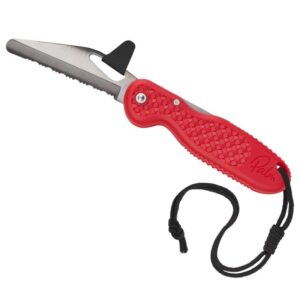
Steel is not just about the name stamped on the blade. You will see codes like 440C, AUS-8 or S30V, each with their own strengths and weaknesses. High-carbon steels are tough and easy to sharpen but rust faster. Stainless steels like 12C27 and VG-10 resist corrosion better but can take longer to sharpen in the field.
Blade grind also plays a role. Scandi grinds are popular for bushcraft thanks to their cutting power and simplicity. Flat grinds are more versatile but can be thinner and less forgiving during rough tasks.
The role of tang, grind and hardness in performance
A full-tang blade means the steel runs through the entire handle. This is the benchmark for strength and reliability. Partial tang designs may work for light use but are more likely to fail when pushed hard.
Hardness is measured on the Rockwell scale. Outdoor knives typically sit between 56 and 61 HRC. Higher numbers mean better edge retention but increased brittleness. A mid-range hardness offers the best balance for Australian conditions.
What to look for in handle materials and balance
Grip matters more than most people realise. Materials like Micarta, G10 and rubberised polymers maintain traction when wet, unlike polished wood or smooth plastics. Comfort is key. If a knife feels awkward in-store, it will feel worse after hours of use.
Balance also affects control and fatigue. A well-balanced knife should feel neutral in hand, not tip-heavy or clumsy. This improves precision and reduces strain during extended tasks.
Not Just for Survivalists: Why Every Explorer Needs a Multi-Tool Knife
The versatility factor: tools you did not know you needed
Multi-tools are not just backups. They often become the most used piece of gear in your kit. From fixing stoves and tightening pack straps to food prep and emergency repairs, their usefulness adds up fast.
You might not use every tool every trip, but when you need one, nothing else will do. That small screwdriver or can opener often becomes the quiet hero of the campsite.
Compact design meets maximum function
Modern multi-tools pack serious capability into compact designs. They are built to be carried daily, deployed quickly, and used repeatedly without falling apart.
The key is choosing one that matches how you adventure. Too many tools add bulk. Too few reduce usefulness. Think realistically about what you fix, cut or adjust when outdoors.
Ideal everyday carry options for bushwalkers and weekend warriors
You do not need to be a survival expert to justify carrying a multi-tool. For bushwalkers, campers and 4WD travellers, it is simple insurance. When something loosens, snaps or jams, you are ready.
Look for features like one-hand opening blades, pocket clips and secure locking mechanisms. These small details make a big difference in daily use.
Avoid Regret: 3 Common Mistakes When Buying Your First Knife
Rookie errors and how to avoid them
Many first-time buyers choose the wrong knife because they focus on looks instead of performance. These common mistakes are easy to avoid with a bit of know-how.
Choosing based on price, not performance
Cheap knives often use soft steel that dulls quickly or weak tang designs that fail under stress. Spending slightly more upfront usually saves money and frustration in the long run.
That said, expensive does not automatically mean better. Focus on materials, construction, and real-world suitability rather than price tags.
Ignoring blade maintenance and corrosion risk
Every knife requires care. Even stainless steel can rust if neglected. Clean and dry your blade after each trip and apply a light oil when storing.
If you spend time in wet or coastal environments, prioritise corrosion resistance. High-carbon blades are excellent performers but demand regular maintenance.
Overlooking legal carry rules in Australian states
Knife laws differ between states and territories. Blade length, carry method and intent all matter. Always check local regulations before heading out, especially when crossing borders.
Carrying a knife for legitimate outdoor use is generally acceptable, but assumptions can lead to trouble. A quick check avoids fines and confiscation.
Knife Know-How Aussies Always Ask
What is the best steel for a survival knife in wet climates?
Stainless steels such as Sandvik 12C27 or AUS-8 offer an excellent balance of corrosion resistance and edge retention for damp environments.
Do I need a full-tang blade for regular hiking?
Not always. Light hikers may be fine with partial tang designs, but full-tang knives provide greater durability and long-term reliability.
Can I legally carry my outdoor knife on hikes?
In most cases yes, when carried for genuine outdoor purposes. Laws vary by state, so always check before you travel.
Your Blade. Your Backup. Your Bush Companion.
A good outdoor knife does more than cut. It protects, prepares and performs when other gear fails. Whether you are upgrading your kit or buying your first serious blade, choosing wisely makes every trip safer and smoother.
Offtrack stocks survival knives and multi-tools built for Australian conditions and tested by people who actually use them outdoors.
Choose gear that will not quit when it counts.
Let’s get Offtrack.