Choosing a climbing harness is not just a matter of comparing prices, colours or product features. The right harness must suit the person wearing it, the type of climbing involved and the way it fits once adjusted.
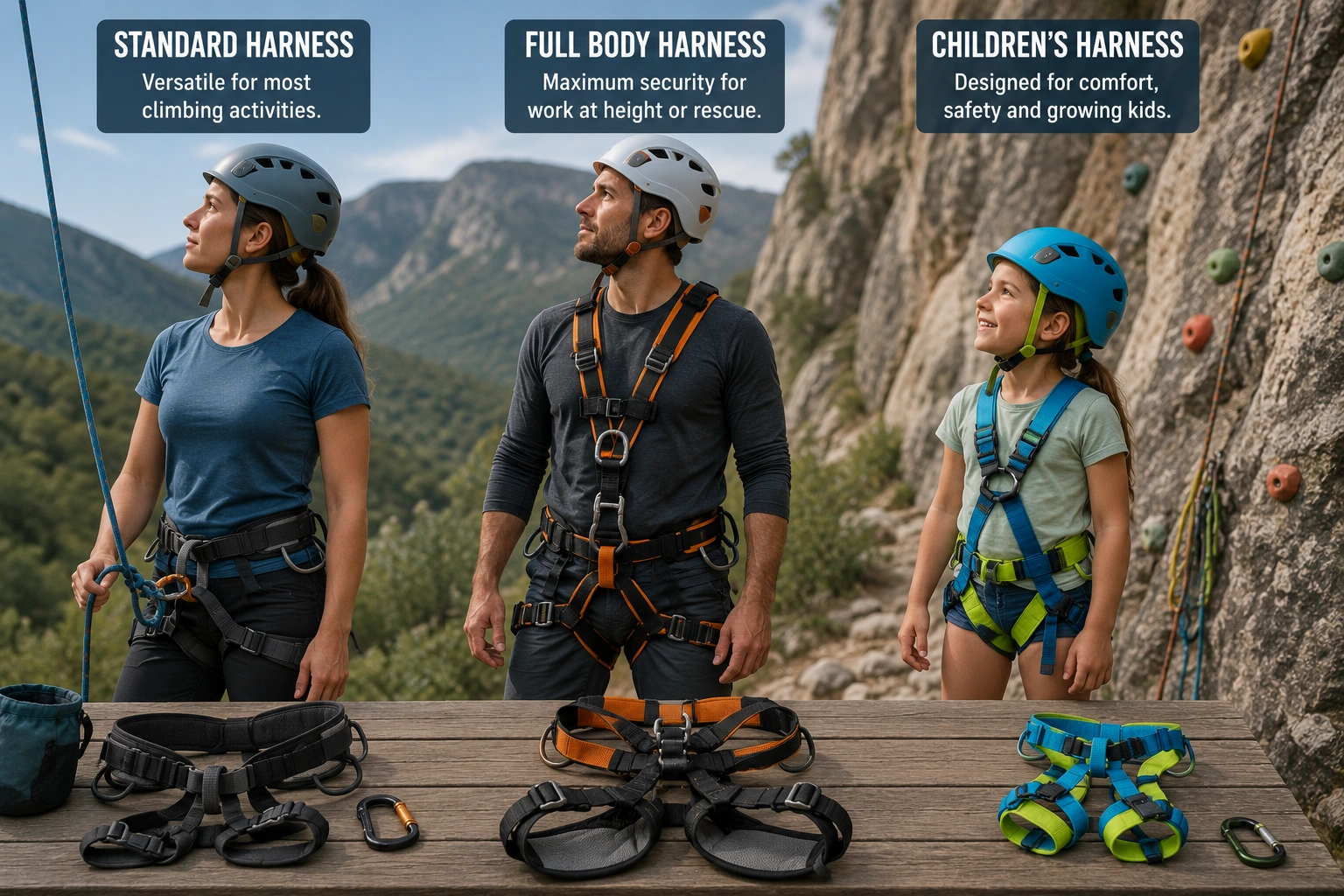
For many adults, a standard sit harness is the most suitable starting point. Younger climbers or users with different body proportions may need a children’s or full body harness instead.
This guide explains the main differences, what to check before buying and how to avoid choosing a harness that does not suit the user.
Always follow the harness manufacturer’s instructions, sizing guidance and intended use information. Where fit or suitability is uncertain, ask a qualified climbing instructor or specialist retailer for advice.
Start with the climber and the activity
Before comparing harness features, identify who will wear the harness and what they will use it for.
Consider:
- The climber’s age, size and body proportions
- Indoor or outdoor use
- Recreational climbing, instruction or group activities
- The manufacturer’s stated weight and size range
- Whether the harness can be adjusted securely
- How often it will be used
An adult climbing regularly at an indoor wall will not necessarily need the same harness as a young child, school participant or climber with particular support requirements.
The activity matters, but it should never be considered separately from the user’s size, shape and fit.
Standard, full body and children’s harnesses compared
| Harness type | Commonly suited to | Main consideration |
| Standard sit harness | Many adult and older youth climbers | Must fit securely around the waist and legs |
| Full body climbing harness | Some children, users with different body proportions and specific instructed activities | Provides support across the torso as well as the waist and legs |
| Children’s harness | Younger users who need child specific sizing or construction | Must suit the child’s current size and proportions |
These are broad categories rather than universal rules. The correct choice depends on the individual harness, the wearer and the manufacturer’s instructions.
When a standard sit harness makes sense
A standard sit harness is the most familiar type used for recreational indoor and outdoor climbing. It wraps around the waist and upper legs and is often suitable for adults and older climbers who fall within the correct sizing range.
A sit harness may be a suitable choice when:
- The manufacturer approves it for the intended activity
- The waist belt sits securely in the correct position
- The harness cannot easily slip down over the hips
- The leg loops fit without excessive looseness or pressure
- All buckles and adjustment points can be secured correctly
- The climber can move comfortably without the harness shifting
Choosing the standard category does not guarantee a correct fit. Two harnesses with similar labels can fit very differently, so sizing should always be checked on the body where possible.
When to consider a full body climbing harness
A full body climbing harness supports the torso as well as the waist and legs. It may be considered where the wearer’s age, proportions, body position or intended activity make a sit harness less suitable.
Some younger children have a higher centre of gravity and less defined hips than adults. Depending on the product and activity, a full body design may provide a more appropriate fit and help the harness remain correctly positioned.
A full body climbing harness may be worth considering when:
- The manufacturer recommends it for the user’s age or size
- A sit harness cannot be adjusted securely
- The wearer’s proportions make waist belt retention uncertain
- The activity provider or instructor requires a full body design
- Additional upper body support is appropriate for the intended use
A full body harness is not automatically the best or safest choice for every climber. It must still fit correctly and be approved for the activity.
It is also important to distinguish recreational climbing harnesses from industrial fall arrest or work at height harnesses. These products are designed for different purposes and should not be treated as interchangeable.
When a children’s climbing harness is the right choice
Parents should avoid buying an oversized harness simply to allow room for growth. A harness must fit the child now, not at some point in the future.
Sport Climbing Australia recommends completing a partner safety check before every climb, including confirming that the harness fits correctly, all buckles are secured and the rope is attached properly. A correctly sized harness is therefore an essential part of the overall safety system, not just a matter of comfort.
Check the manufacturer’s minimum and maximum sizing, weight guidance and intended age range. Do not rely on the word “children’s” alone.
How should a climbing harness fit?
A harness should feel secure and stable without causing unnecessary discomfort. It should remain correctly positioned when the climber moves and when the harness is loaded as instructed.
Check the waist belt
The waist belt should sit in the position specified by the manufacturer, commonly above the hips rather than low around them.
Once adjusted:
- It should feel snug
- It should not slide down easily
- It should not twist or fold
- The buckle must be secured exactly as instructed
- The adjustment range must remain within the manufacturer’s limits
Do not use a simple finger width rule as a substitute for the manufacturer’s fitting instructions. Harness designs vary.
Check the leg loops
Leg loops should fit securely without restricting normal movement.
Look for:
- No excessive looseness
- No painful pressure points
- Even positioning on both legs
- Correct buckle and strap alignment
- Enough adjustment to stay within the approved range
Some harnesses have fixed leg loops, while others are adjustable. Neither design is universally better. The correct choice depends on fit and intended use.
Check overall stability
After adjustment, the harness should remain stable while the wearer moves, bends and follows any loading or suspension check recommended by the manufacturer or climbing facility.
Stop and reassess the fit if:
- The waist belt moves into an unsafe position
- The harness shifts excessively
- Straps twist or loosen
- The wearer cannot move comfortably
- Any buckle or adjustment point is difficult to secure
- The size sits at or beyond the stated adjustment limit
Where possible, test the harness under the supervision of a qualified instructor or experienced retailer.
What schools and instructors should consider
Schools, climbing centres and instructors often need to select harnesses for a wider range of users.
The buying decision should consider:
- Participant age and size range
- The activity being delivered
- Manufacturer instructions
- Adjustment range
- Ease of checking buckles and straps
- Inspection and retirement procedures
- Staff training
- Consistency across the equipment pool
- Cleaning and storage requirements
A harness that works well for one individual may not be suitable for a mixed group. Organisations should have a documented fitting, inspection and supervision process rather than relying on a single harness type for every participant.
Price should come after suitability
A climbing harness sale can offer good value, but only when the harness already meets the user’s needs.
A discount does not compensate for:
- Incorrect sizing
- Poor fit
- The wrong harness category
- Unclear intended use
- Missing manufacturer information
- Damage, age or uncertain product history
Choose the correct type first. Confirm the fit and intended use. Then compare price, features and value within the suitable category.
Avoid buying used harnesses unless their history, age, storage conditions and inspection status can be verified. Safety equipment with an unknown history may have hidden damage or may already be beyond the manufacturer’s recommended service life.
Five questions to ask before buying
1. Who will wear the harness?
Consider the climber’s age, size, proportions and experience.
2. What activity is it for?
Check whether the harness is designed for indoor climbing, outdoor climbing, supervised group use or another specific activity.
3. Does the manufacturer approve it for this user?
Review the size range, weight range, intended use and fitting instructions.
4. Can it be adjusted securely?
The harness should remain stable without sitting at the extreme limit of its adjustment range.
5. Has the fit been checked properly?
Where possible, try the harness on and ask a qualified person to confirm the fit before use.
Which climbing harness should you choose?
Choose a standard sit harness when:
- The user falls within the approved size range
- The waist belt remains securely positioned
- The intended activity suits a sit harness
- The harness can be adjusted comfortably and correctly
Consider a full body harness when:
- The wearer’s age or proportions make a sit harness less suitable
- The manufacturer or activity provider recommends one
- Additional torso support is appropriate for the intended use
Choose a children’s harness when:
- The product is designed for the child’s current size and proportions
- The manufacturer approves it for the activity
- It offers a more secure fit than an adult harness
Climbing harness inspection and replacement
Fit is only one part of harness safety. Inspect the harness before use in line with the manufacturer’s instructions.
Check for:
- Cuts, fraying or damaged stitching
- Worn tie in points
- Cracked or damaged buckles
- Chemical or heat exposure
- Discolouration or damaged webbing
- Missing labels or unreadable safety information
- Any change that makes the harness difficult to adjust
Retire the harness immediately after a severe loading event or when required by the manufacturer. Follow the stated product lifespan even if the harness appears undamaged.
Frequently asked questions
Do I need a full body climbing harness?
Not necessarily. A full body harness may be appropriate where the wearer’s age, proportions or intended activity make it a better fit. Follow the manufacturer’s guidance and seek qualified advice when uncertain.
Can a child use an adult climbing harness?
Only when the manufacturer approves the harness for the child’s size and the harness fits securely. An adult harness should not be used simply because it can be tightened.
Is a standard climbing harness suitable for beginners?
Often, yes. Experience level alone does not determine harness type. The user’s size, proportions, activity and fit are more important.
How tight should a climbing harness be?
It should be snug, stable and adjusted within the manufacturer’s approved range. It should not slide out of position or cause painful restriction.
What is the difference between a sit harness and a full body harness?
A sit harness supports the waist and upper legs. A full body climbing harness also supports the torso. Each design suits different users and activities.
Is a climbing harness on sale worth buying?
Yes, provided it is the correct type, size and fit for the user and has a clear, verifiable history. Price should not override suitability.
When should a climbing harness be replaced?
Replace it according to the manufacturer’s lifespan and retirement guidance, or sooner if it has sustained a severe load, visible damage, chemical exposure or uncertain storage conditions.
Choose by fit and intended use
The best climbing harness is not necessarily the cheapest, most technical looking or most familiar option. It is the one designed for the activity, approved for the user and capable of being adjusted securely.
Start with the climber. Confirm the intended use. Check the manufacturer’s sizing and fitting guidance. Then compare suitable products within the correct category.
Browse our standard, full body and children’s climbing harnesses, or contact our team for help narrowing down the most appropriate options.