Swag vs bivvy vs tent: the right shelter depends on how you travel, how far you carry your equipment, the conditions you expect and how much sleeping space you need.
If you’re replacing an old swag, it’s worth considering whether the same shelter format still suits the way you camp.
A swag that works well beside your vehicle may become inconvenient when carried for several hours. A lightweight hiking shelter can reduce weight and packed bulk, but may involve different compromises in setup, weather protection and living space.
Tarps offer another option for campers who prefer a flexible, minimalist shelter system.
Before comparing brands, think about how you’ll use the shelter. Will it travel in a vehicle or on your back? Do you want a simple sleeping space or enough room to sit up and organise gear? How much weather protection and setup flexibility do you need?
These questions will help you identify the shelter type that best suits your trips.
Before You Buy Another Swag, Decide How Far You Need to Carry It
Transport is one of the quickest ways to narrow your shelter options.
If your equipment travels in a ute, wagon or 4WD and only needs to move a short distance to camp, weight and packed size may be less important.
If you’re carrying everything on foot for several hours, those factors become much more significant.
A shelter that feels manageable beside a vehicle may be impractical when added to a hiking load containing food, water, clothing, cooking equipment and a sleeping system.
Offtrack’s Tents & Shelter range includes different shelter systems suited to camping and hiking.
A Good Vehicle-Camping Shelter Can Be a Poor Hiking Shelter
A heavier or bulkier shelter isn’t necessarily a poor choice when your vehicle can carry it comfortably.
Vehicle campers may prefer a familiar, self-contained sleeping setup and accept additional packed volume in return.
Hikers have different priorities.
Every item contributes to the total load, so the weight and dimensions of a shelter can affect the rest of the packing system.
Before choosing a shelter type, establish how far you’ll carry it and how much packed space is available.
Then consider the expected weather, sleeping space and setup requirements.
What a Camping Swag Does Well
A camping swag can provide a straightforward personal sleeping setup.
For solo campers and vehicle-based trips, this simplicity is often a major attraction.
A swag creates a defined sleeping area without necessarily requiring the same arrangement of separate components as other shelter systems.
The exact setup depends on the particular model, but familiarity and convenience can make a swag appealing for regular vehicle camping.
A Self-Contained Setup Has Real Appeal
A swag may suit someone who values:
- A defined personal sleeping space
- Straightforward camp organisation
- A familiar setup routine
- Simple solo use
- Convenient transport from a vehicle to camp
These are useful qualities when most of your camping takes place close to your vehicle.
If they remain your priorities, another swag may be a sensible replacement for an older model.
Packed Bulk Still Belongs in the Decision
A swag can be convenient at camp while taking up considerable storage space.
This matters when using a smaller vehicle or carrying camping equipment for several people.
Before replacing an older swag, compare the packed dimensions of suitable current products.
A familiar design may still work well, but the amount of space it occupies should remain part of the decision.
Replacing an Old Swag? Work Out What Needs to Change
If you’ve owned a swag for years, you probably know what you liked about it.
Perhaps it was easy to set up, provided enough personal sleeping space or fitted naturally into your vehicle-camping routine.
You may also have found aspects frustrating.
Before buying another shelter, identify what you want to keep and what you want to improve.
Consider:
- Setup: Was the shelter straightforward to establish at camp?
- Sleeping space: Did it provide enough room for comfortable use?
- Packed bulk: Was it difficult to store or transport?
- Ventilation: Did airflow suit the conditions you camped in?
- Weather protection: Did the shelter meet your needs in wet or windy conditions?
- Access and organisation: Was it easy to enter, leave and manage equipment?
Your camping habits may also have changed.
You might now use a smaller vehicle, walk further from the road or want more covered space for clothing and gear.
If you still camp close to your vehicle and value a familiar sleeping arrangement, another swag may be appropriate.
If carrying weight, packed size or additional living space has become more important, it’s worth comparing bivvies and lightweight tents before replacing like-for-like.
The aim is to keep the features you value while addressing the limitations of your previous shelter.
Swag vs Bivvy: Similar Footprint, Different Priorities
A bivvy is one of the most compact alternatives to a swag.
Both can provide a small one-person sleeping footprint, but they generally prioritise different things.
A swag tends towards a more self-contained campsite sleeping arrangement.
A bivvy places greater emphasis on compact transport and minimal packed bulk.
The differences become especially relevant when you need to carry the shelter as part of a hiking load.
Bivvies Make More Sense When Carrying Efficiency Matters
A bivvy may be worth considering when:
- Packed size needs to remain small
- Carried weight is a major consideration
- Campsite space is limited
- You’re comfortable with minimal internal room
- You prefer a compact shelter system
That compactness involves compromises.
A bivvy usually offers limited room for movement and equipment organisation. Ventilation and moisture management can also become more noticeable when the sleeping system sits close to the shelter walls.
Some campers prefer additional covered space for changing clothing or managing wet gear.
A bivvy therefore isn’t simply a smaller or better swag. It prioritises efficient carrying over the room and convenience offered by other shelter styles.
A Lightweight Tent Solves Problems a Single Swag Does Not
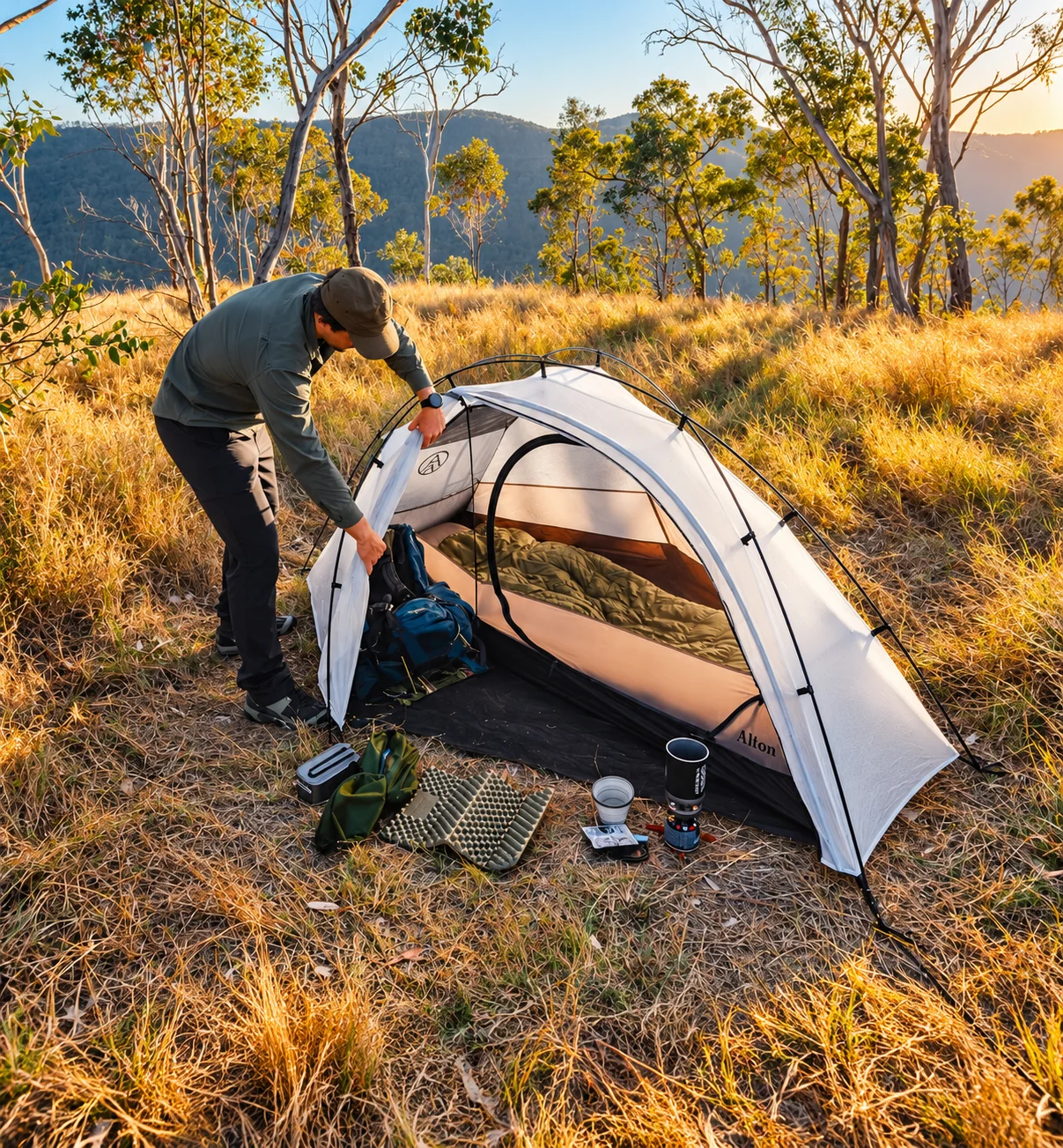
A lightweight solo or two-person tent offers another balance between carried weight and usable shelter space.
One of its main advantages is the potential for more enclosed living room.
Depending on the design, a lightweight tent may provide space to sit up, change clothing, organise equipment or store wet items in a vestibule.
For longer trips or poor weather, that additional space can become particularly valuable.
According to the Tasmania Parks and Wildlife Service, walkers undertaking its registered overnight walks must carry a quality tent with a 3–4 season rating and both inner and outer layers. The requirement helps ensure walkers have suitable shelter if huts are unavailable, injuries delay their journey or weather conditions deteriorate. This highlights the value of considering shelter construction and expected exposure when comparing lightweight tents with more minimalist options.
For longer trips or poor weather, that additional space can become particularly valuable.
More Space Can Be Worth More Setup
A lightweight tent may involve more separate components than a minimalist shelter.
Depending on the model, these can include:
- Poles
- Pegs
- Fly
- Inner
- Groundsheet
- Vestibule
- Guy lines
These components may add to setup time and complexity, but they can also contribute to a more enclosed and organised sleeping area.
For someone spending several nights in wet weather, the extra room may be worth the additional setup.
Compare the Complete System
When comparing shelters, look beyond the headline product weight.
Consider everything you need to carry and use.
For a tent, that may include poles, pegs and ground protection.
For a swag, consider the complete packed setup and any additional weather protection you normally use.
For a bivvy, include the sleeping mat, ground protection or tarp you intend to pair with it.
Comparing complete systems gives you a more useful picture of weight, packed bulk and functionality than comparing shelter names alone.
A Tarp Gives You Flexibility, but You Supply More of the System
Tarps sit at the modular end of shelter selection.
They can appeal to hikers who value compact packing, low weight and the ability to adjust a shelter pitch to suit the campsite.
The trade-off is that more of the shelter’s performance depends on how it is set up.
Fewer Walls Mean More Decisions
Using a tarp may require greater attention to:
- Wind direction
- Drainage
- Ground conditions
- Insects
- Splashback
- Pitch shape
- Guy points
- Protection of the sleeping system
This flexibility can be useful for experienced campers who want control over their shelter arrangement.
For someone who prefers a more enclosed setup with fewer decisions at camp, a tent, swag or bivvy may be more appealing.
Swag, Bivvy, Tent or Tarp? Compare the Differences
Each shelter type offers a different balance of transport, sleeping space, setup and weather management.
| Decision factor | Swag | Bivvy | Lightweight tent | Tarp / minimalist shelter |
| Transport | Often suited to vehicle camping | Prioritises compact carry | Balances carrying needs and usable space | Often selected for low weight and flexibility |
| Sleeping and living space | Defined personal sleeping area | Minimal internal space | More potential enclosed space | Depends on the pitch |
| Setup | Generally straightforward, depending on design | Usually compact with fewer components | May involve poles, pegs, fly and inner | More dependent on site conditions and pitching method |
| Weather management | Depends on product construction | Close-fitting protection with ventilation considerations | Enclosed system with model-dependent protection | Strongly influenced by pitch and exposure |
| Packed bulk | Important to assess | Usually a key strength | Varies considerably by design | Often a key consideration |
| Often suits | Vehicle-based solo camping | Minimalist carried shelter | Hiking where enclosed space matters | Campers wanting a flexible, low-weight setup |
These are broad category differences rather than specifications for individual products.
The final choice should still be based on the actual shelter’s construction, dimensions, weight and intended use.
Weather Protection Is More Than Canvas Versus Nylon
Material names don’t tell the whole story about weather protection.
Canvas isn’t automatically the best choice for every wet-weather trip, and nylon shouldn’t be dismissed simply because it is a lighter material.
The complete shelter design matters.
Check the Shelter Construction
When comparing products, look at:
- Floor construction
- Seam treatment
- Ventilation
- Entry design
- Fabric specifications
- Water management around openings
- Manufacturer weather guidance
These details apply across swags, bivvies, tents and tarps.
A shelter’s performance depends on its overall construction and how it is used, not simply the material named in the product description.
Ventilation Belongs in the Weather Conversation
Keeping external rain out is only one part of shelter performance.
People also produce moisture while sleeping.
In smaller shelters, condensation can become particularly noticeable because there is less internal space and the sleeping system sits closer to the walls.
Ventilation therefore deserves attention alongside fabric waterproofing and seam construction.
A shelter may resist external rain while still becoming uncomfortable if airflow is inadequate for the conditions.
Vehicle Campers and Hikers Need Different Buying Checklists
The same shelter can make sense for one style of camping and be impractical for another.
Once you know how the shelter will be transported, the most important buying considerations become clearer.
If You Camp From a Vehicle
Focus on:
- Sleeping comfort
- Setup convenience
- Durability
- Vehicle storage space
- Campsite footprint
- Compatibility with the rest of your camping equipment
Weight can still matter, particularly when storage space is limited, but it may not dominate the choice.
A swag or other self-contained camping shelter may suit this style of travel when its dimensions and features match your needs.
If You Carry the Shelter on Foot
Pay closer attention to:
- Total carried weight
- Packed dimensions
- Weather protection
- Setup complexity
- Usable interior space
- Versatility
- How the shelter fits into your total hiking load
For longer walks, the weight and bulk of the complete shelter system become more important.
A bivvy, lightweight tent or tarp may offer advantages depending on how much interior space and weather protection you need.
Choose the Shelter That Solves Your Camping Needs
Swags, bivvies, lightweight tents and tarps all have useful roles.
A swag may remain the best fit for straightforward vehicle-based camping.
A bivvy may suit someone prioritising compact carry and a minimal sleeping footprint.
A lightweight tent can provide more enclosed space for equipment and time spent inside during poor weather.
A tarp offers flexibility for campers comfortable managing a more modular shelter system.
The best choice comes from matching those trade-offs to the way you camp.
Before buying, compare the complete shelter systems you’re considering, including packed dimensions, carried weight, sleeping space, construction and setup requirements.
You can explore Offtrack’s Tents & Shelter range to review available shelter options.
If you’re replacing an old swag or deciding between different shelter types, contact Offtrack.
Tell us how you travel, how far you carry your shelter and what conditions you expect. That provides a useful starting point for narrowing your options before comparing individual products.
Frequently Asked Questions About Swags, Bivvies and Tents
Is a Swag Better Than a Tent for Solo Camping?
Not necessarily.
A swag can suit vehicle-based solo camping where a simple, self-contained sleeping setup is important.
A lightweight tent may be more appropriate when you’re carrying the shelter and want additional enclosed space for yourself or your equipment.
Can I Take a Camping Swag Hiking?
Potentially, but consider the complete weight and packed dimensions of the specific swag.
Compare those details with the distance you intend to carry it and the other equipment in your hiking load.
A bivvy or lightweight tent may be worth considering if weight and packed bulk are important.
What Is the Difference Between a Swag and a Bivvy?
Both can provide compact one-person shelter.
A swag generally favours a more self-contained campsite sleeping arrangement, while a bivvy places greater emphasis on compact carrying.
Compare the specific products for weather protection, ventilation, sleeping space, packed dimensions and weight.
Should I Replace an Old Swag With Another Swag?
Only if the format still suits your camping needs.
If you value its familiar setup and continue camping close to your vehicle, another swag may be appropriate.
If you’ve changed vehicles, started carrying your equipment further or want different living space, compare alternative shelter styles first.
What Should I Check Before Buying a Single Swag?
Review the specific product’s:
- Complete weight
- Packed dimensions
- Sleeping dimensions
- Ventilation
- Floor construction
- Seam treatment
- Entry design
- Intended use
Also consider how you’ll transport and store it.
Are Bivvies Suitable for Camping in Australia?
They can suit some camping and hiking trips.
The decision depends on the specific bivvy, expected weather, ventilation, insect management and how much internal space you need.
A bivvy is one compact shelter option rather than a universal replacement for a swag or tent.
What If I Specifically Searched for a Wild Country Swag?
Check whether the particular Wild Country swag you remember is still available from the retailer you’re considering.
Don’t assume an older model or familiar brand name means that the product remains in current stock.
If it isn’t available, identify the qualities you valued, such as setup, sleeping space or transport convenience, and compare current shelters against those requirements.