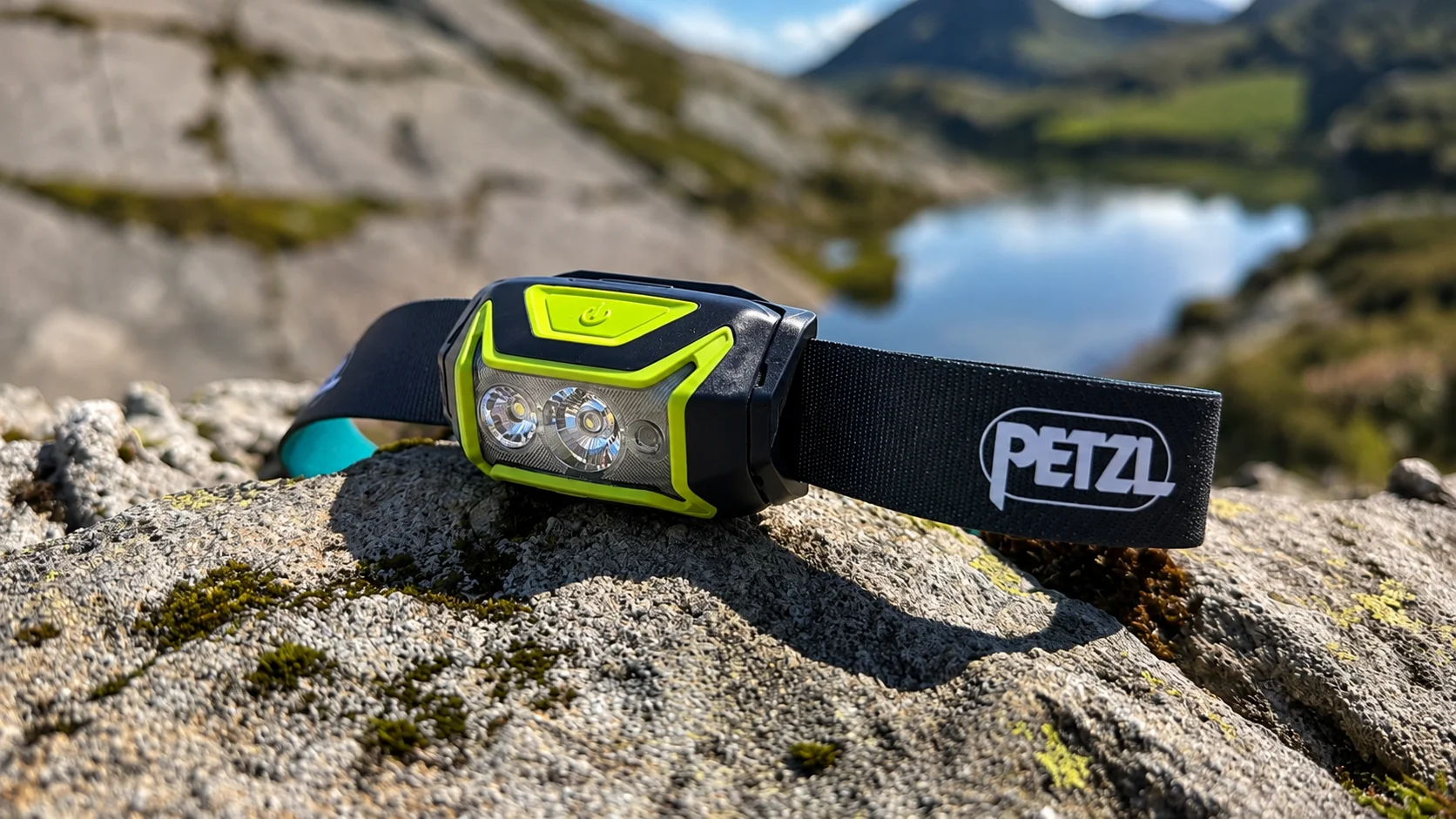
Petzl Tikka vs Actik is a useful comparison if you’re choosing a head torch for camping, bushwalking or hiking after dark. Both offer practical lighting features, but they’re designed for slightly different needs. The Tikka provides a wide, comfortable beam for close-range activities, while the Actik offers greater reach for walking and navigating unfamiliar tracks.
The difference becomes clearer when you think about where you’ll use your head torch. Cooking dinner or organising gear around camp doesn’t require the same lighting as following a rocky track after sunset. Brightness matters, but so do beam pattern, battery life and how you plan to keep the torch powered.
Both Petzl families include red lighting, multiple brightness settings and compatibility with AAA and rechargeable CORE batteries. The standard models come with AAA batteries, while the CORE versions include rechargeable power and offer higher maximum output.
At Offtrack, we recommend choosing a head torch around your activities, the distance you need to see and how long you’ll be relying on it. This guide compares the Tikka, Tikka Core, Actik and Actik Core to help you decide which model suits your next trip.
Petzl Tikka vs Actik: Which Beam Suits Your Activity?
Before comparing lumen ratings, consider what you actually need to illuminate.
Around camp, most tasks happen within a few metres. Preparing meals, pitching a tent and finding equipment inside your pack usually benefit from a broad spread of light rather than a concentrated beam.
Walking after dark places different demands on your head torch. You may need to identify obstacles, follow track markers or see bends in the trail further ahead.
This is where the main difference between the Tikka and Actik becomes apparent.
Where the Petzl Tikka Makes Sense Around Camp
The Petzl Tikka uses a wide, uniform beam designed for comfortable close-range lighting. It suits activities where you’re frequently looking between nearby objects, such as cooking, organising equipment or moving around a campsite.
The standard Tikka produces up to 350 lumens using its supplied AAA batteries, with a published maximum beam distance of 70 metres.
For routine camp tasks, you’re unlikely to need maximum brightness all the time. Its lower settings provide gentler illumination while reducing battery use.
The Tikka also includes red lighting, which can be useful when you want to avoid shining bright white light towards other campers. Lower-intensity red light can help preserve night adaptation, although it won’t suit every task.
A phosphorescent reflector helps you locate the torch in the dark, while a lock function reduces the risk of accidentally switching it on inside your bag.
For established campsites, casual evening walks and general outdoor use, the Tikka offers a practical combination of straightforward controls and close-range lighting.
When the Petzl Actik’s Mixed Beam Is More Useful
The Petzl Actik offers a wide or mixed beam, giving you useful illumination nearby while directing more light towards objects further ahead.
With its supplied AAA batteries, the Actik produces up to 450 lumens and has a published maximum beam distance of 100 metres.
That additional reach can be useful when you’re walking across uneven ground, looking for track markers or checking the route ahead.
The distinction isn’t simply that the Actik produces more light. Its mixed-beam design distributes that light differently from the Tikka’s wide beam.
This explains why two head torches with similar brightness ratings can have different beam distances.
We’d give the Actik closer consideration for regular night walking, overnight bushwalking trips and activities where seeing further along the track matters.
If your head torch will mostly be used for cooking, reading and moving around camp, the Tikka may already provide the lighting you need.
Petzl Tikka vs Actik: Specifications Compared
The Tikka and Actik families each include a standard AAA-powered model and a rechargeable CORE version.
Comparing all four makes it easier to understand how brightness, beam pattern and power source affect performance.
Maximum lumens are useful, but they don’t tell the whole story. Beam distance depends on how the light is distributed, while runtime depends on the brightness setting and battery being used.
Brightness, Beam Distance, Runtime and Weight
The following table compares the four models using their supplied power sources.
| Specification | Tikka | Tikka Core | Actik | Actik Core |
| Maximum brightness | 350 lm | 450 lm | 450 lm | 625 lm |
| Maximum beam distance | 70 m | 75 m | 100 m | 115 m |
| Beam pattern | Wide | Wide | Wide or mixed | Wide or mixed |
| Supplied power | 3 AAA | CORE battery | 3 AAA | CORE battery |
| STANDARD brightness | 100 lm | 100 lm | 100 lm | 100 lm |
| STANDARD runtime | 12 h | 7 h | 10 h | 7 h |
| MAX POWER runtime | 2 h | 2.5 h | 2 h | 2 h |
| Weight | 94 g | 84 g | 98 g | 88 g |
| Weather resistance | IPX4 | IPX4 | IPX4 | IPX4 |
Figures are from Petzl’s published specifications. Brightness, distance and runtime refer to the operating modes and supplied batteries shown. Published runtime should not be interpreted as constant full-output lighting for the entire period.
The comparison highlights three points worth considering before buying.
The Actik provides greater beam reach. Both the AAA-powered Actik and the rechargeable Tikka Core produce up to 450 lumens, but their published maximum distances are 100 metres and 75 metres respectively. Beam pattern accounts for much of that difference.
CORE power changes maximum brightness. The Tikka family reaches 350 lumens with AAA batteries and 450 lumens with CORE. The Actik family reaches 450 lumens with AAA and 625 lumens with CORE.
The weight differences are relatively small. The rechargeable models are lighter than their AAA-powered counterparts when fitted with their supplied batteries. For most campers, beam pattern and power management will matter more than a few grams.
Are the Tikka and Actik Waterproof?
All four models have an IPX4 weather-resistance rating.
This means they’re designed to resist splashing water, including normal rain exposure. That’s useful for camping and bushwalking, where your equipment may be exposed to changing weather.
However, IPX4 doesn’t mean a head torch is suitable for immersion.
We wouldn’t recommend treating either family as a submersible light. If your activity involves a substantial risk of the torch being submerged, consider equipment with a higher water-resistance rating.
Petzl Tikka vs Actik Battery Life and Runtime
A head torch advertised with 100 hours or more of burn time can sound ideal for a multi-day trip. However, that figure usually refers to its lowest white-light setting, not continuous operation at maximum brightness.
Petzl publishes different runtimes for different lighting modes and power sources. Understanding those figures helps you plan more reliably, particularly when you’ll be walking after dark.
Understanding Low, Standard and Maximum Lighting Modes
The Tikka and Actik families have three main white-light settings.
MAX BURN TIME prioritises battery life through low-output lighting. It’s intended for close-range tasks where powerful illumination isn’t necessary.
STANDARD balances brightness and runtime. For general campsite use and straightforward walking, this is often a more useful setting to compare than maximum output.
MAX POWER provides the greatest brightness and beam distance, but uses more energy.
With AAA batteries, the Tikka produces 7 lumens in its lowest mode and has a published runtime of 110 hours. The Actik also produces 7 lumens, with a published runtime of 100 hours.
Both provide approximately 10 metres of lighting distance at this setting. That’s useful for nearby tasks, but it isn’t a substitute for stronger illumination when navigating difficult terrain.
At STANDARD brightness, both families produce 100 lumens.
With AAA batteries, the Tikka has a published runtime of 12 hours and the Actik 10 hours. With CORE batteries, both families are rated for seven hours at the same brightness.
At maximum output, the AAA-powered Tikka and Actik are each rated for two hours. With CORE power, the Tikka family is rated for 2.5 hours and the Actik family for two hours.
Petzl publishes these figures using the ANSI/PLATO FL 1 testing protocol. The measurements follow defined testing criteria and don’t guarantee unchanged brightness throughout the entire rated period.
Some settings also provide reduced-output reserve lighting after the main runtime. This shouldn’t be counted as additional time at the selected brightness.
Battery condition, temperature and switching between modes can affect how long your torch remains useful. Allowing spare capacity is more sensible than planning around the exact published limit.
How Much Runtime Do You Need for an Evening Hike?
Suppose you’re planning a walk that could continue for three hours after sunset.
A head torch with a two-hour maximum-power runtime isn’t automatically unsuitable. You may only need maximum brightness occasionally, such as when checking a difficult section of track.
For much of the walk, STANDARD mode may provide enough illumination.
However, changing between settings makes total runtime harder to predict. Before leaving, consider the longest time you might be outdoors, including delays, and the level of lighting required by the terrain.
An established path and a rocky, unfamiliar track may demand different levels of illumination.
We recommend carrying suitable spare power or another reliable light, particularly for remote walking. A mobile phone shouldn’t be your only backup when you may also need it for navigation or communication.
For routine camp activities, lower settings make battery management relatively straightforward. Longer walks after dark deserve more careful planning.
AAA vs CORE Batteries: Which Should You Choose?
Both the Tikka and Actik families use Petzl’s Hybrid Concept, allowing them to operate with compatible AAA batteries or a rechargeable CORE battery.
The standard models are supplied with three AAA batteries, while the CORE versions include rechargeable power.
This gives you flexibility, but it’s worth choosing a battery arrangement that suits how often you’ll use the head torch and whether you’ll have access to charging during your trip.
Rechargeable Convenience, Spare Batteries and Compatibility
For regular use, CORE power can be convenient. You can recharge the battery between outings rather than repeatedly replacing disposable batteries.
The Tikka Core and Actik Core use Petzl’s rechargeable CORE battery, which has a published charging time of approximately 3.5 hours and charges through USB-C.
If you frequently use a head torch for evening walks, camping or outdoor education activities, maintaining a charging routine may make preparation easier.
Multi-day trips require more thought. Without access to charging, compatible spare AAA batteries provide another power option.
Both families can use alkaline, lithium or compatible Ni-MH rechargeable AAA batteries, allowing you to choose a power source that suits your trip.
The important point is that AAA and CORE batteries don’t produce identical lighting performance.
CORE power provides higher maximum brightness in both head torch families. However, AAA batteries offer longer published runtime at the 100-lumen STANDARD setting.
Neither arrangement is automatically better. Rechargeable power may suit frequent use, while replaceable AAA batteries can be convenient when charging isn’t available.
For outdoor education groups, we’d also consider how batteries will be managed across several participants.
A group using AAA-powered head torches may find it straightforward to carry standardised spares. A group using CORE batteries needs a reliable system for charging, checking and distributing batteries before each activity.
The better arrangement is the one your group can maintain throughout the program.
Which Petzl Head Torch Is Best for Camping or Hiking?
Choosing between the Tikka and Actik becomes easier once you’ve identified your main activity.
If most of your lighting needs are close to camp, a broad beam and straightforward controls may be more useful than additional distance.
If you regularly walk after dark, greater beam reach becomes more valuable.
Here’s how we’d approach the decision.
Camping, School Groups and Casual Night Walks
For general camping, we’d start with the Tikka.
Its wide beam suits cooking, setting up tents, finding equipment and walking around established campsites. The single-button control makes changing lighting settings straightforward, while the lock function helps prevent accidental activation during transport.
The phosphorescent reflector is another useful feature when you’re trying to locate your head torch in the dark.
The Tikka Core suits similar activities but includes rechargeable power and a higher maximum brightness when using its CORE battery.
For school camps and outdoor education programs, we’d also consider how easily participants can operate and maintain the equipment.
A straightforward head torch may be more appropriate for routine campsite activities than one chosen primarily for its maximum output.
Participant experience, supervision, battery management and the planned activities should all influence the decision.
If a program includes night navigation, the Actik’s additional beam distance may be useful. For a campsite-based program, that extra reach may not be necessary.
Bushwalking, Overnight Hikes and More Demanding Tracks
For regular walking after dark, we’d give the Actik closer consideration.
Its mixed beam provides useful nearby illumination while allowing you to see further along the track. This can help when you’re following uneven terrain, identifying obstacles or checking the route ahead.
With AAA batteries, the Actik has a published maximum beam distance of 100 metres, compared with 70 metres for the Tikka.
Using CORE power, the Actik family reaches a published maximum of 115 metres, compared with 75 metres for the Tikka family.
These are maximum ratings, not distances you’ll achieve at every brightness setting or in every condition.
We recommend using the lighting level appropriate for your pace, terrain and visibility rather than operating at maximum power throughout a walk.
The Actik Core may appeal to people who want rechargeable power and the highest maximum brightness within these four models.
However, if your head torch spends most of its time illuminating a cooking area or the inside of a tent, that additional output may offer little practical benefit.
Choose according to your most demanding realistic use, then consider how you’ll manage battery power.
Compare Petzl Head Torches at Offtrack
The Petzl Tikka and Actik are both practical options for camping and hiking, but they’re suited to slightly different priorities.
The Tikka’s wide beam makes it a sensible choice for campsite tasks, casual evening walks and activities where close-range lighting matters most.
The Actik provides greater beam reach for regular night walking and bushwalking where seeing further ahead is useful.
Both families support AAA and CORE battery options, so your decision should also account for how often you’ll use the torch and whether you’ll have reliable access to charging.
Before choosing, consider the distance you need to see, the brightness you’ll use most often and how you’ll keep the torch powered throughout your trip.
Match the Beam, Battery and Runtime to Your Plans
At Offtrack, we help campers, hikers and outdoor educators compare equipment suited to their activities.
For an established campsite, comfortable close-range lighting and straightforward controls may take priority.
For an overnight bushwalk that involves travelling after dark, beam distance, battery capacity and backup lighting deserve greater attention.
You can compare options in our head torch range or explore our broader camping and hiking lighting equipment if you’re preparing a complete campsite setup.
Petzl Tikka vs Actik: Frequently Asked Questions
Is the Petzl Actik worth choosing over the Tikka for hiking?
If you regularly hike after dark, the Actik’s mixed beam and greater maximum distance may be useful for identifying terrain further ahead.
For established campsites and straightforward walks, the Tikka’s wide beam may provide sufficient lighting. The better choice depends on your terrain and how often you need longer-range visibility.
How much brighter is the Actik than the Tikka?
Using their supplied AAA batteries, the Tikka produces up to 350 lumens and the Actik up to 450 lumens.
With CORE batteries, the Tikka family reaches 450 lumens and the Actik family reaches 625 lumens.
The Actik also offers greater maximum beam distance, so comparing lumens alone doesn’t explain the full difference in performance.
Does the Petzl Tikka have a rechargeable battery?
The standard Tikka comes with three AAA batteries but is compatible with Petzl’s rechargeable CORE battery, which is available separately.
The Tikka Core includes the rechargeable battery. Both versions can also operate with compatible AAA batteries.
Does the Actik last longer than the Tikka?
Not necessarily. At the 100-lumen STANDARD setting with AAA batteries, the Tikka has a published runtime of 12 hours, compared with 10 hours for the Actik.
With CORE batteries, both families are rated for seven hours at the same brightness.
The Actik provides greater beam reach, but that doesn’t automatically mean longer battery life.
Are the Tikka and Actik waterproof enough for wet-weather hiking?
Both families have an IPX4 weather-resistance rating, meaning they’re designed to resist splashing water, including normal rain exposure.
They’re not intended for immersion. For wet-weather bushwalking, check that the battery compartment is properly closed and protect spare batteries from moisture.
Which Petzl head torch would we recommend for a school camp?
For general campsite activities, we’d start by considering the Tikka. Its wide beam, straightforward controls and flexible power options suit many routine camp tasks.
For night navigation or activities requiring greater visibility ahead, the Actik may be more suitable.
Participant experience, supervision, terrain and battery management should also influence the choice.
Find the Right Petzl Head Torch for Your Next Trip
The best head torch is one that provides enough light for your activities, lasts for the time you need it and has a power setup you can manage reliably.
For campsite tasks and occasional evening walks, the Tikka is a practical starting point. If you regularly hike after dark or need to identify terrain further ahead, the Actik’s additional beam reach may be worth choosing.
At Offtrack, we can help you compare lighting equipment for camping, hiking and outdoor education based on the activities and conditions you’re preparing for.
Explore our head torch range or contact our team to discuss your equipment requirements.